
CUSTOMER SUCCESS STORY
Okakichi Intelligent Customer Service System
Company Profile
Okakichi is a game development company founded by renowned Japanese game producer Yoshiki Okamoto. Centered on innovative gameplay and Okamoto’s distinctive production style, the company focuses on developing and publishing mobile games for iOS and Android, with an emphasis on combining innovative mechanics with unique themes. The company currently faces several core challenges: highly concurrent customer service inquiries caused by the cyclical nature of games and version updates; insufficient multilingual support; the need to tailor communication scripts to cultural differences across markets; customer attrition due to delayed service responses; and difficulties in training customer service staff.
Migration Technology
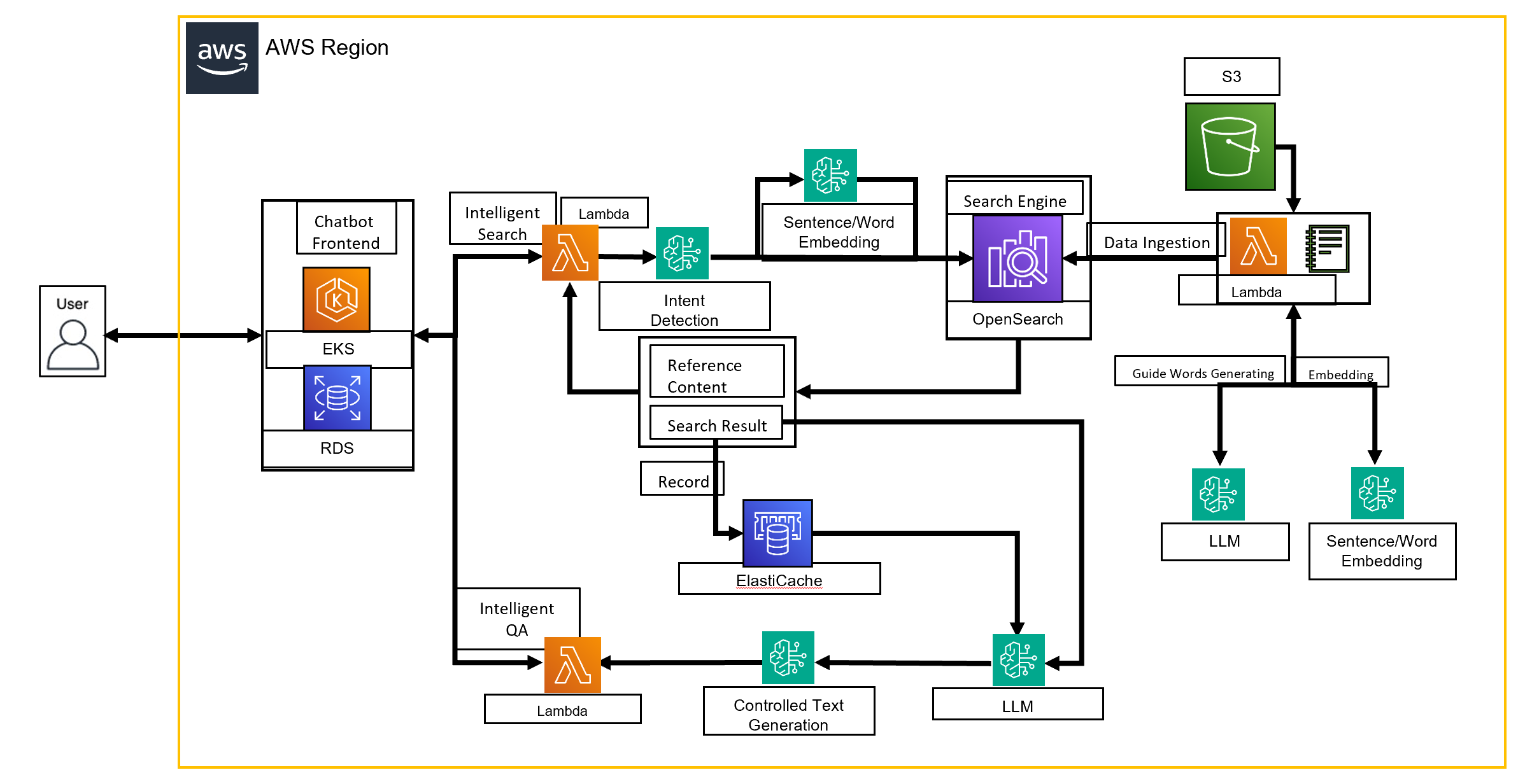
- The solution uses Claude 4 on Amazon Bedrock to improve system accuracy and efficiency. Model routing reduces costs, while fully managed AWS services improve platform availability and lower maintenance costs.
- For reliability, the solution us›es Amazon S3 with S3 Intelligent-Tiering for storage and a dual-region, Multi-AZ architecture with Amazon Route 53 failover, achieving 99.95% platform availability.
- For performance efficiency, the solution uses Amazon EKS Auto Scaling, Redis caching, and Amazon OpenSearch Service to provide elastic resources and efficient access.
- For operational excellence, the solution uses full-stack monitoring with Amazon CloudWatch, CI/CD, and automated deployment with AWS CloudFormation, greatly simplifying operations and maintenance.
- The security design uses layered VPC isolation, end-to-end encryption with AWS KMS, least-privilege IAM permissions, AWS CloudTrail, AWS WAF, and other security services.
- The data layer uses Amazon RDS for MySQL, Amazon DocumentDB, Amazon ElastiCache for Redis, and Amazon OpenSearch Service to improve search efficiency and hit rates.
Client Benefits
- Economic benefits and cost optimization. Significant reduction in total cost of ownership (TCO): The project reduced overall TCO by 50%. Compute cost optimization: Strategies including EC2 Auto Scaling, Amazon EKS, and Reserved Instance optimization reduced compute costs by 30%. Storage cost optimization: S3 Intelligent-Tiering and lifecycle management reduced storage costs by 45%. Amazon Bedrock model routing and caching reduced costs by 20%. Network cost optimization: Amazon CloudFront CDN acceleration and caching reduced network bandwidth costs by 50%.
- Improved operational efficiency and productivity. More efficient knowledge retrieval and generation: Through AI-driven retrieval-augmented generation (RAG), customer service knowledge retrieval efficiency improved by 96.7%, significantly reducing the time required to obtain information. Shorter ticket handling time: AI-generated ticket content and an efficient knowledge base shortened the customer complaint handling cycle by 70%. High-performance AI services: The AI question-answering service has an average response time of less than two seconds, meeting customer service needs for understanding player issues and providing real-time answers.
- Value creation and risk control. Improved user experience and satisfaction: The user Net Promoter Score (NPS) increased substantially from 65 to 80. In particular, faster handling of urgent issues such as account security prevented player attrition caused by waiting. Business continuity: Based on AWS Multi-AZ and a highly available architecture, the system achieves 99.95% availability. Data security and reliability: AWS KMS encryption and Amazon S3 durability provide eleven nines of data durability, effectively controlling the risk of data loss and leakage. Technological leadership: Amazon Bedrock’s multi-model hosting capabilities enable the platform to continuously integrate the latest AI technologies and maintain the enterprise’s technological competitiveness.