
CUSTOMER SUCCESS STORY
Qoinpay Intelligent Investment Analysis and Decision Support Assistant
Company Profile
Qoinpay focuses on the financial industry and operates as a small digital currency exchange. It has established influence in the financial sector and broad business coverage, providing end-to-end solutions and services to more than 100 financial institutions, including securities firms, futures companies, funds, trusts, insurers, banks, exchanges, and private equity firms. Through continuous innovation and solution optimization, the customer actively embraces new technologies and applies cutting-edge capabilities such as artificial intelligence, big data, and blockchain to financial services. Drawing on extensive industry experience and a professional technical team, the customer has a deep understanding of the business needs and pain points of different financial institutions. However, under the traditional financial services model, financial institutions face numerous challenges. First, limited data processing and analytical capabilities make it difficult to extract valuable insights quickly from massive volumes of financial data, reducing decision-making accuracy. Second, customer service is costly and inefficient and cannot meet increasingly diverse and personalized customer needs. Risk management is also under tremendous pressure, as institutions struggle to accurately predict and prevent various financial risks.
Migration Technology
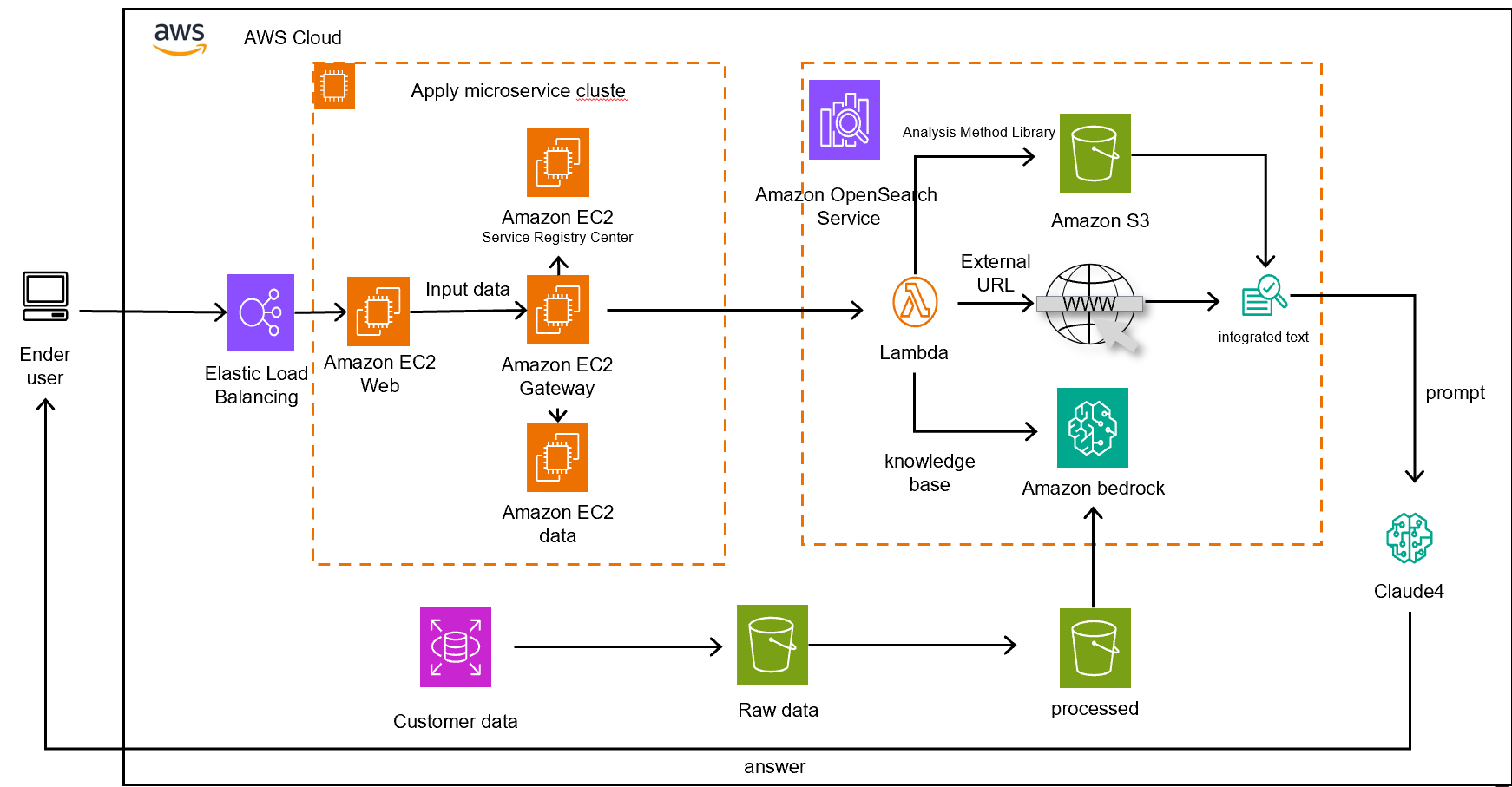
Data Input and Preprocessing
▪ Users submit input data through a web interface. An Amazon EC2 instance receives and preprocesses the data.
▪ The preprocessed data is divided into customer data and an analytical methods library, which are stored in separate Amazon S3 buckets: the raw data bucket and the processed data bucket.
Data Storage and Management
▪ Raw data bucket: Stores original customer data to ensure data integrity and traceability.
▪ Processed data bucket: Stores processed and cleansed data for subsequent analysis.
▪ Amazon S3: Stores the analytical methods library and consolidated text, supporting data sharing and persistent storage.
Computing and Analysis
▪ The Amazon EC2 instance handles data preprocessing and external URL generation, serving as the hub for data flow.
▪ A knowledge base module, which may be the knowledge base interface of an AI model, combines the processed data with the methods library to generate consolidated text.
▪ The consolidated text is used as prompt input to invoke the Claude 3 AI model for intelligent analysis and answer generation.
Results Delivery
▪ Answers generated by Claude 3 are written back to the processed data bucket for front-end display or further processing.
▪ The web application displays the analytical results based on the answer, enabling user interaction.
Client Benefits
Improved business efficiency and service quality: By deploying the intelligent investment assistant, financial institutions can significantly overcome the staffing limitations of traditional investment advisory services. The system can operate continuously, 24 hours a day, seven days a week, substantially expanding customer coverage and resolving the problem of advisors being unable to respond promptly to every customer. The AI system delivers standardized and consistent professional services, ensuring that every customer receives stable, high-quality investment advice and eliminating fluctuations in service quality caused by differences among advisors. The system integrates core capabilities such as customer understanding, market analysis, viewpoint distillation, and compliance management. It automatically matches services to each customer’s circumstances, enabling genuinely personalized investment recommendations, ultimately improving customer satisfaction and strengthening the financial institution’s market competitiveness.
2. Quantified performance and cost benefits: The project has set clear quantitative targets. System response time will not exceed two seconds, substantially reducing wait times compared with traditional human service. Data accuracy will exceed 90%, ensuring the reliability of investment recommendations. The target user satisfaction score is 90, system availability will reach 99.99%, and the system will handle at least 1,000 queries per second (QPS). These metrics enable financial institutions to serve more customers at a lower marginal cost and improve operational efficiency. From a cost perspective, the cloud-native architecture is expected to reduce total cost of ownership by 60% to 70% compared with a traditional self-hosted solution. It avoids major up-front investments in hardware procurement and data center construction, while the pay-as-you-go model makes costs more controllable. In addition, AI assistance reduces the time advisors spend on repetitive tasks, allowing them to focus on higher-value customer relationship management and complex investment strategy development, thereby increasing the overall value of services and the potential for business revenue.